 St. Bartholomew’s Episcopal Church has a deep and long history dating back over 100 years in Ho-Ho-Kus.
Originally settled by the Leni Lenape Indians and the Dutch, Ho-Ho-Kus is rich in Revolutionary War history. Ho-Ho-Kus is home of the Hermitage, a gothic revival mansion listed as a National Historic Site. Washington, Hamilton, Lafayette, and other British notables of the time were entertained at the Hermitage by its mistress, Theodosia Prevost. Aaron Burr courted her, and they were married there in 1782.
Residents today are also reminded of the town’s historical past by the Ho-Ho-Kus Inn. Situated in the center of the business district, it also dates to the Revolutionary period.
People often ask, “What is the meaning of Ho-Ho-Kus?”. From our town website, “As is the case with many names of Indian origin, there can be many interpretations.”
It is an Indian word for running water. It means cleft in the rock or under hollow rock. It comes from the Hohokes signifying the whistle of the wind against the bark of trees.It is named from the Chihohokies Indians whose Chief lived here.
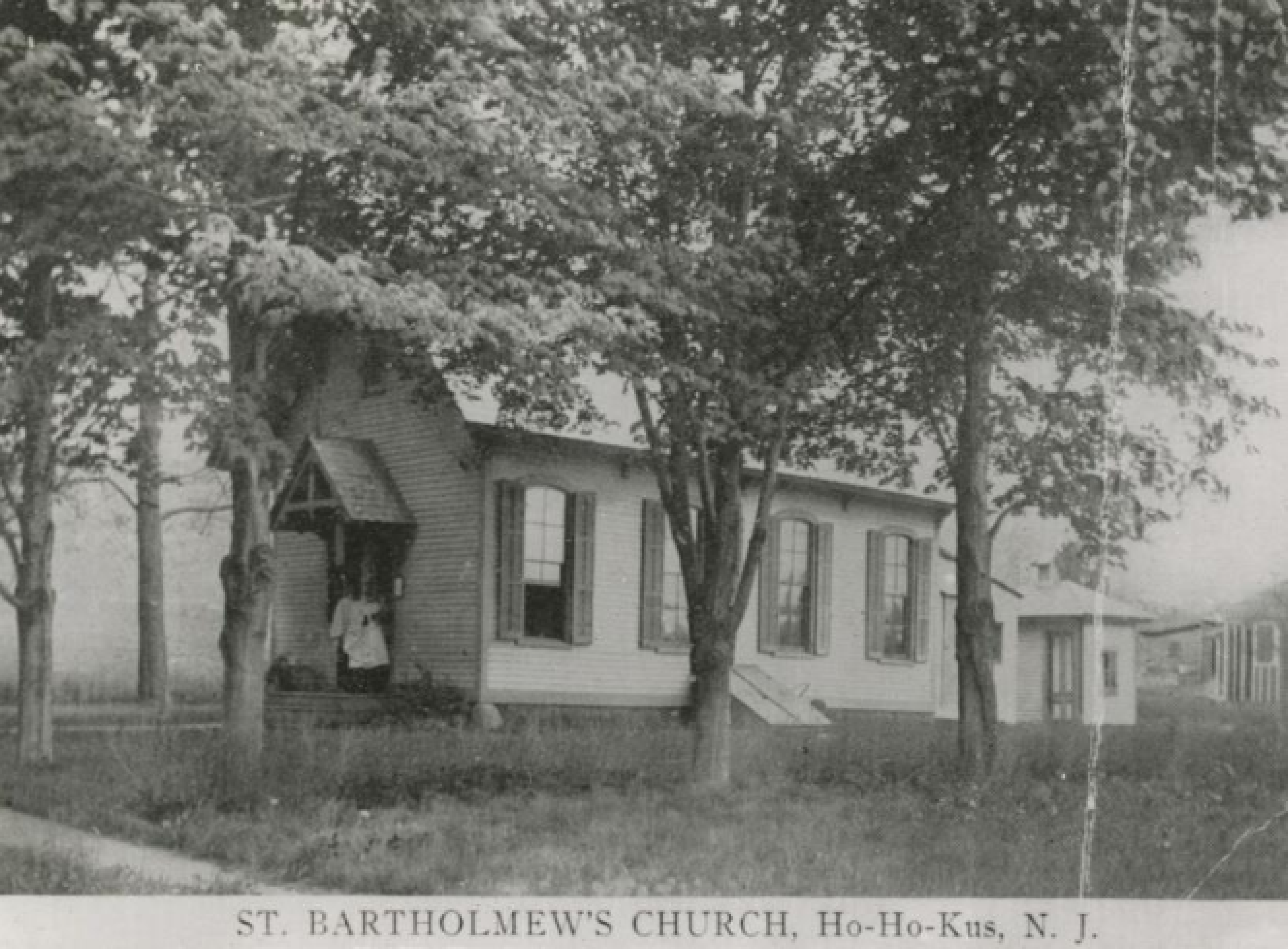
Many changes have taken place in the growth physical presence and spiritual community which is now St. Bartholomew’s Church. In 1904 the “little schoolhouse”, unused since 1880, on Hollywood Avenue became St. Bartholomew’s Chapel, a mission of Christ Church, Ridgewood. In 1914 Bishop Edwin Lines gave his consent to the establishment of St. Bartholomew’s Church, an exciting venture for 53 supportive families.
A donation of land, in 1927, on Sheridan Avenue, the present site, motivated the building of a Parish House in 1930. Even though the parish suffered financial losses during the depression, the congregation was able to add to the physical presence of the Parish by purchasing a rectory on Hollywood Place in 1942. In 1948 the old “schoolhouse” was moved to the Sheridan Avenue site and became the nave and narthex, seating 80, in a unified single unit structure. A sanctuary and chapel were added to the church and a parish house unit at the same time.
The 1950s brought further interest and expansion. The nave was enlarged to seat 187, the old church and sanctuary were rebuilt, a sacristy was added, and eight church school classrooms were added to the parish house. In 1967 the parish house and kitchen were modernized, and new church windows were added. In 1959 the church office was redesigned, and eight more classrooms were constructed. The facilities were further enhanced with the acquisition of a new pipe organ. In 1980 the parish hall underwent a full window replacement.
St. Bartholomew’s has owned four different rectories over the course of time. The current rectory, located next door to the church, was purchased in 1997. Recently, it has undergone renovation and updating work including a refinished wood floor to prepare it for our next Rector. The grounds of the rectory have a vegetable and floral garden with areas that offer time for private reflection. The large back yard provides opportunities for play and gatherings of family, friends and parishioners.
St. Bartholomew’s had nine rectors over its 103-year history. Our most recent rector was with us for 33 years. Many members of our congregation were children when Rev. Dan Kreller began his ministry at St. Bartholomew’s.
One of our rectors, The Rev. Judson Child, Jr. became the Suffragan Bishop then Diocesan Bishop in the Diocese of Atlanta. He also served as the Chancellor of the University of the South, his Alma Matter.